Cell Types
Cell type annotations on VFB.
Neurons on VFB are annotated with cell types from the Drosophila Anatomy Ontology (FBbt).
A cell type is a class — an ontology term for a type of neuron — as opposed to an individual reconstructed or imaged neuron, which is an instance of one.
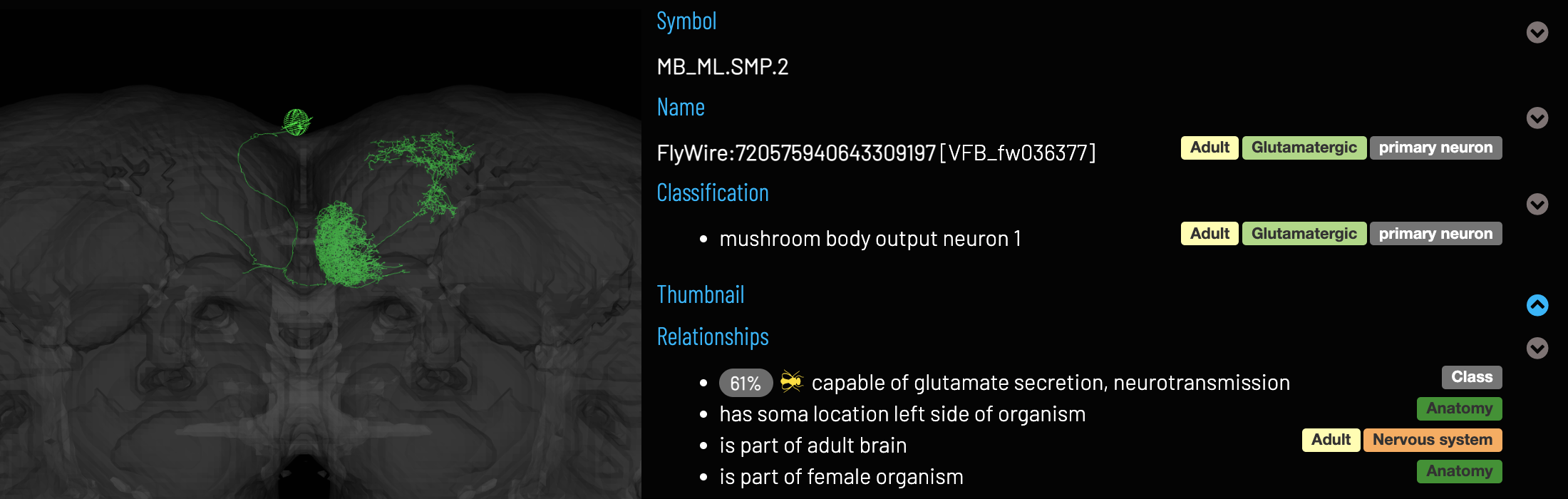
Why do we use ontology terms?
- Each term represents a concept of a cell type, with a definition based on referenced publications:
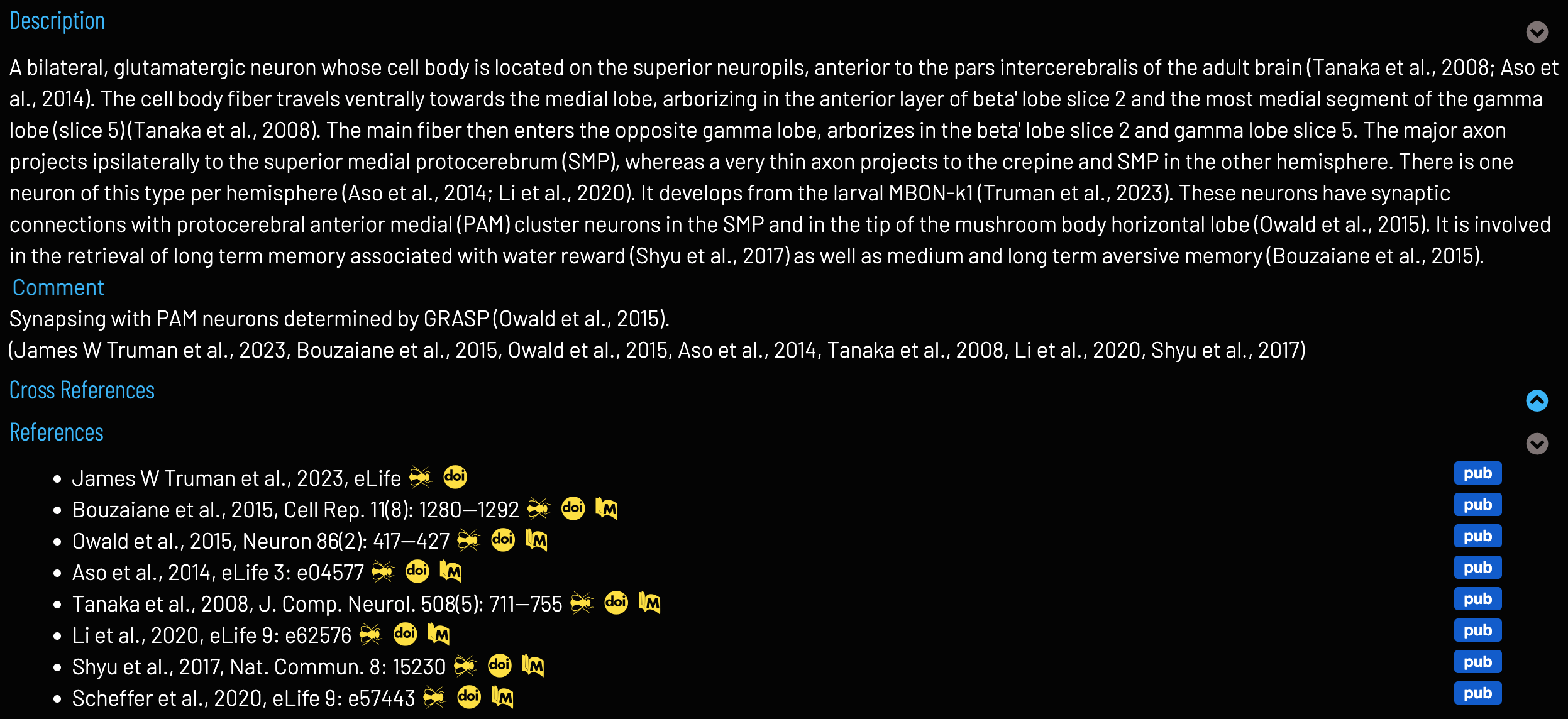
- As well as a label, each term has a collection of synonyms, facilitating identification even when the same type has been referred to by different names in different sources:
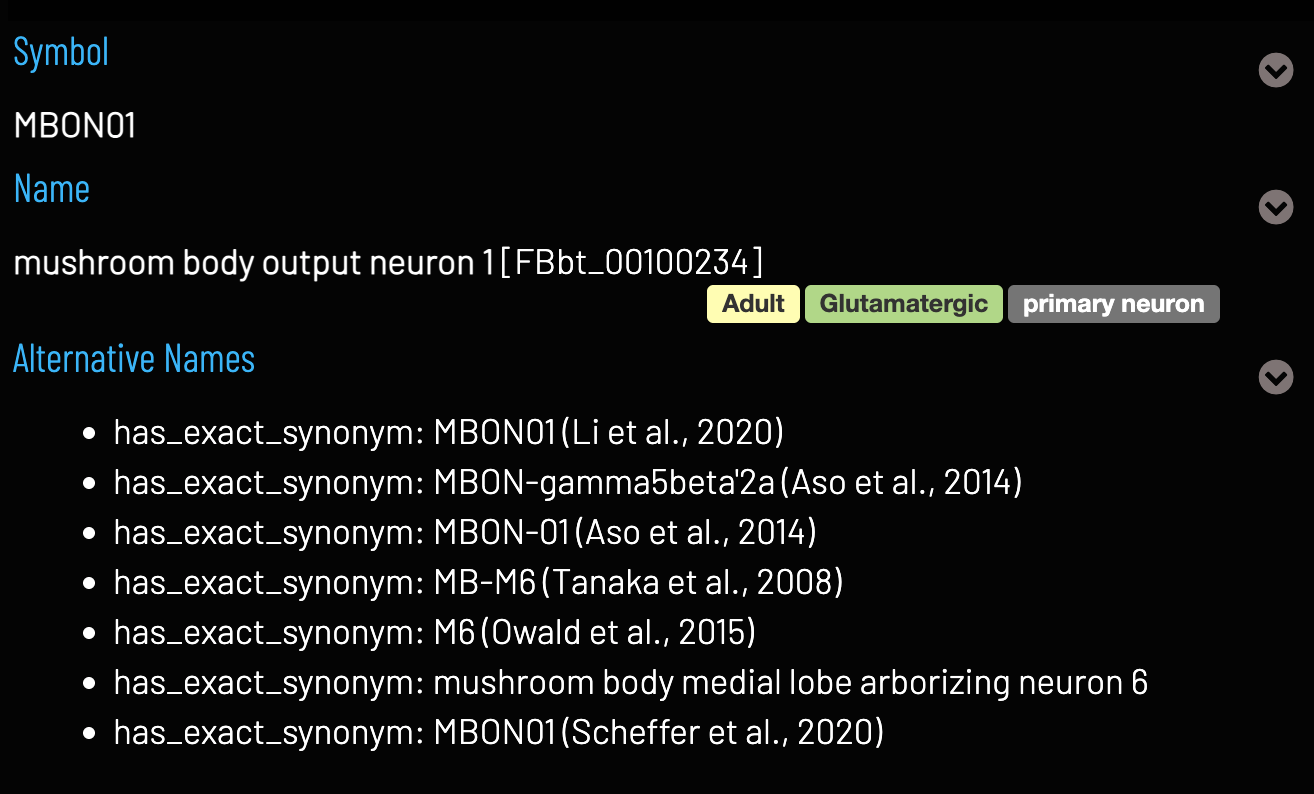
- Hierarchical – e.g. specific terms for MBON01, MBON02 etc., but also grouped by a general MBON term and all under ‘adult neuron’
- Neurons of the same type in multiple datasets can be linked to the same ontology term
- Persistent, resolvable identifiers to uniquely identify cell types e.g. https://virtualflybrain.org/reports/FBbt_00100234
We also use terms from the Drosophila Anatomy Ontology to annotate CNS regions (for the Template ROI Browser tool and neuron connectivity per region query) and other anatomical features.
What defines a cell type here
A DAO cell type is not defined by a picture or by a name — it is defined by properties, and the classification follows from them. The worked example in the original schema paper is the DL1 adPN: an antennal lobe projection neuron whose soma sits in the antennal lobe cortex, with post-synaptic terminals in antennal lobe glomerulus DL1, pre-synaptic terminals in the lateral horn and the mushroom body calyx, developing from the antero-dorsal antennal lobe neuroblast. State those facts and a reasoner concludes, without anyone asserting it, that DL1 adPN is a subclass of adPN (Osumi-Sutherland et al., 2012).
The relations doing the work are a small set: has_soma_location, fasciculates_with, has_synaptic_terminal_in (with pre- and post-synaptic forms), synapsed_to, upstream_in_neural_path_with, innervates and develops_from, all layered on part_of. Because these propagate over the part hierarchy, a query aimed at a whole neuropil also returns neurons annotated against one of its subregions.
What is in the ontology, and what is not
The DAO admits a named class only where there is good scientific evidence for the presence of that structure in wild-type animals, with links to the literature supporting it; classes added in error have been obsoleted. Much of the hierarchy is not asserted by hand but inferred — part_of and capable_of relations combined with Gene Ontology process terms let a reasoner derive classifications, and disjointness axioms catch contradictions (Costa et al., 2013).
At the time of the VFB 2023 paper the ontology covered around 13,000 neuroanatomical structures and cell types, including over 9,800 terms for neuron types, curated from more than 1,000 papers; over 3,800 of those neuron types are predicted from connectomics data, and over 2,750 have curated lineage (Court et al., 2023).
For where the underlying data and the naming standards came from, see which fly is this?